Adult Electric Tricycles: Understanding Types and Uses
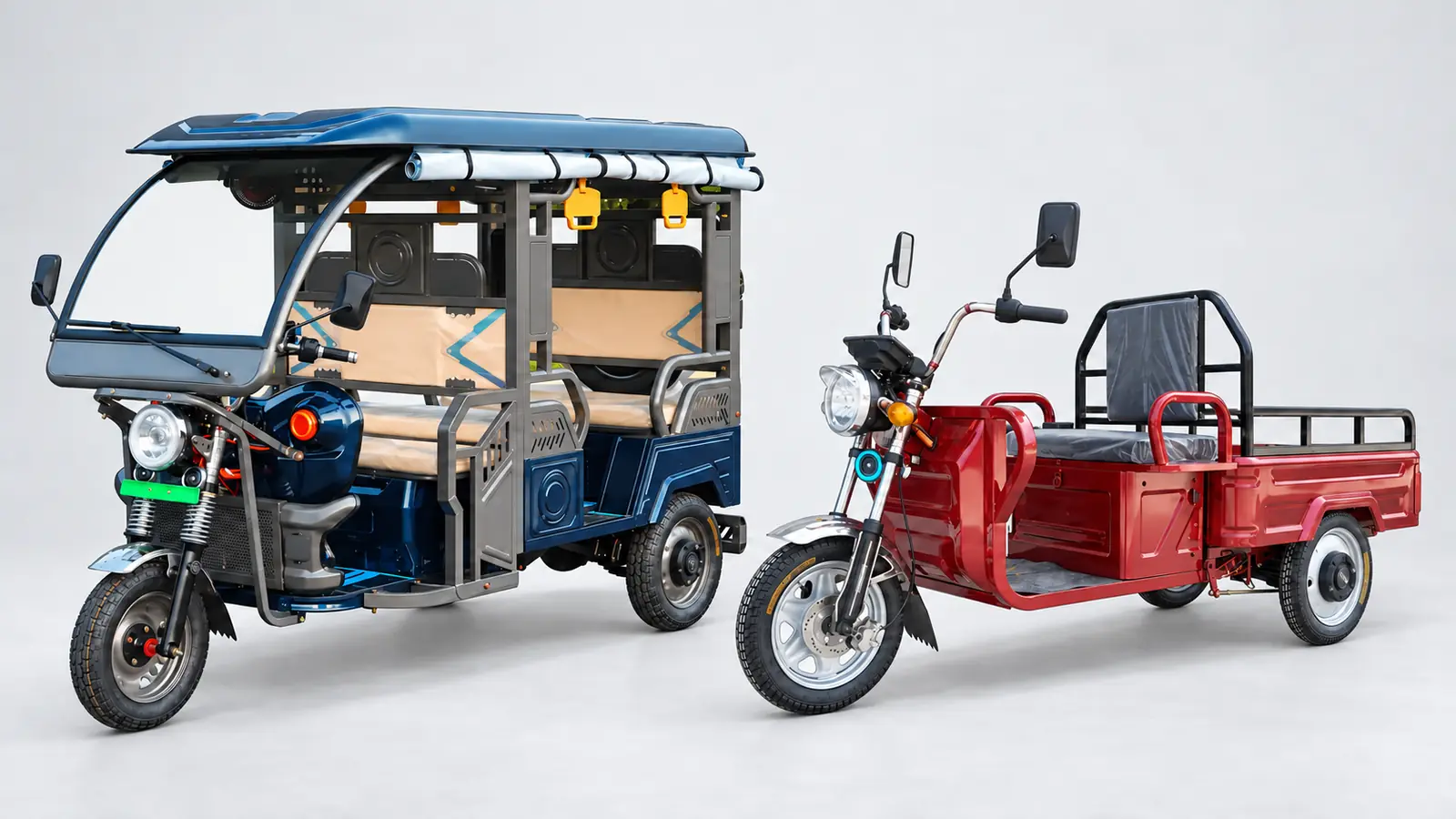
Adult electric tricycles differ in how they are driven, what they carry and how their bodies are arranged. “Adult” describes the intended user; “electric” means that a motor contributes to propulsion. Those labels alone do not tell you whether the vehicle supports pedalling, provides additional passenger seats or has a dedicated cargo area.
The useful starting point is the task. Personal riding, passenger transport and goods delivery place different demands on the vehicle. Ecogo’s passenger and cargo tricycles illustrate why this matters: two models can share a motor specification while serving different purposes. Understanding the type first makes it easier to compare vehicles built for the same job.
What “Adult” and “Electric” Describe
An adult tricycle can rely on human power, use a motor to assist pedalling, or use motor power as its main means of propulsion. “Adult” therefore identifies the user group without defining the drive system. It also does not establish that a particular vehicle fits every adult.
Electric describes the involvement of a motor. The way that motor is controlled is a separate characteristic, as are the seating arrangement and the space provided for goods.
These descriptions work together:
| Description | What it identifies | How it helps the comparison |
|---|---|---|
| Adult | The intended user group | Relates the vehicle to the rider’s fit, seating and controls |
| Electric | Motor propulsion or assistance | Leads to the pedal-drive and motor-control requirements |
| Passenger or cargo | The intended transport role | Directs attention to passenger accommodation or loading space |
| Canopy, cabin or enclosed | A covering or compartment | Identifies the areas to protect and how they are accessed |
A vehicle can be an adult-use electric tricycle, a passenger carrier and a covered model at the same time. These are complementary descriptions.
For a local transport service, the passenger electric tricycle range provides a more useful starting point than a broad search for adult tricycles. Once the transport role is clear, individual seating and body layouts become easier to compare.
Identify the Drive System and Controls
The drive system determines how effort reaches the wheels. The controls determine how the rider requests motor power. Keeping those two questions separate avoids confusion between a pedal cycle with electric assistance and other motor-driven three-wheelers.
Check for a Working Pedal Drivetrain
Functional pedals connect the rider’s effort to the driven wheel through a mechanical transmission. A footrest supports the rider’s feet, while a brake pedal operates the braking system. Neither replaces a pedal drivetrain.
For someone who wants to pedal for personal travel or exercise, a working pedal drivetrain is a basic requirement. A non-electric tricycle for adults relies on that human-powered drive. An electric model may retain the pedal drivetrain and add motor assistance.
The practical distinction is whether turning the cranks propels the vehicle. A component description containing the word “pedal” does not answer that question if it refers to a foot brake. The drive specification or operating instructions should describe the function.
Check How the Motor Is Activated
Pedal assistance supplies motor support in response to pedalling. A throttle lets the rider request motor output through a separate control. These functions can coexist on one tricycle.
That combination matters when comparing riding methods. A rider who wants motor support while continuing to pedal needs a suitable pedal-assist system. A rider who wants motor propulsion without continuous pedalling needs an operating mode that explicitly supports it. The presence of a throttle alone does not describe all of its operating conditions.
For a battery-powered adult tricycle, the useful information is the available mode and what the rider must do to activate it. Motor wattage cannot establish whether the vehicle requires pedalling, permits independent throttle operation or offers both.
Separate Vehicle Use From Body Style
The intended load shapes the vehicle choice. Body coverage then needs to protect the people or goods involved. A roof over the driver, for example, answers a different requirement from an enclosed cargo compartment.
Distinguish Personal Riding, Passenger Transport and Cargo Use
Personal riding centres on the rider’s own journey. Seating position, access to the controls and the intended riding method need to work together. When pedalling is part of that journey, the vehicle must provide a functional pedal drive; adding a motor does not remove that requirement.
Passenger transport starts with designated passenger accommodation. Seats, access and the space available to occupants define whether the layout suits the service. A bench or cargo platform should not be counted as passenger accommodation unless it is specified for that purpose.
Passenger count and loading capacity also answer different questions. The seating configuration identifies where occupants can sit, while the loading specification sets a mass limit under the manufacturer’s definition. One figure cannot replace the other.
Goods delivery starts with the load itself. The cargo electric tricycle range is relevant when carrying goods is the main task. Both the mass and dimensions of those goods matter: a light but bulky load can outgrow the available space before reaching the vehicle’s loading limit.
A shopping basket on a personal trike and a dedicated cargo body provide different loading arrangements. Their suitability depends on the actual goods, how they enter the load area and how the vehicle is configured to carry them. Where passengers and goods must travel together, the seating and loading arrangement needs to support that combined use.
Read Canopy, Cabin and Enclosed Descriptions Carefully
An electric tricycle with a canopy provides overhead coverage, but its sides may remain open. The important detail is the area beneath that covering. A canopy over the driver does not provide the same coverage as one extending over passenger seating.
A cabin describes a compartment. Its position determines whether it serves the driver, passengers or another part of the vehicle. An enclosed electric tricycle may have a closed driver’s cab while its cargo area remains open.
The application makes the distinction practical:
- For passenger transport, coverage needs to be considered around the occupied seating area and its access points.
- For goods that need shelter, the relevant feature is protection around the cargo space. A closed driver’s cabin does not provide that protection for an open load area.
- For frequent loading and unloading, doors, openings and access to the goods matter alongside the extent of the enclosure.
Photographs and layout drawings help establish these relationships. Sealing and weather resistance are separate performance questions; a roof or closed compartment should not be treated as proof of a particular protection level.
Explore Ecogo’s Passenger and Cargo Tricycles
Ecogo’s ZB-8FLEXI SUPER Passenger Electric Tricycle is a covered model for local passenger transport and short-distance shuttle work. Its role makes passenger seating, access and accommodation the starting points for a closer comparison.
The ZB1124 Compact Cargo Electric Tricycle serves short-distance delivery, daily service routes and light commercial hauling. For this model, the first questions concern the goods to be carried and the loading space they require.
| Specification | ZB-8FLEXI SUPER | ZB1124 |
|---|---|---|
| Vehicle type | Covered passenger electric tricycle | Compact cargo electric tricycle |
| Main application | Local passenger transport and short-distance shuttle work | Short-distance delivery and light commercial hauling |
| Overall vehicle dimensions | 2800 × 1000 × 1800 mm | 2450 × 880 × 1220 mm |
| Specified loading capacity | 350 kg | 260 kg |
| Motor specification | 60V 1200W | 60V 1200W |
The ZB-8FLEXI SUPER and ZB1124 share a 60V 1200W motor specification, but that does not make them interchangeable. Passenger accommodation and goods-carrying space remain different requirements. A matching voltage and wattage figure cannot establish equivalent driving performance or suitability for the same task.
Overall dimensions describe the outside of the vehicle, which is useful when considering storage and access. They do not provide passenger seat spacing, doorway clearance or the internal dimensions of the cargo area.
For the same reason, the 350 kg and 260 kg loading figures should remain mass specifications. They do not establish passenger counts. A meaningful comparison uses the dimensions and capacity relevant to the intended function, alongside the model’s electrical specification.
Confirm the Vehicle Type Before Comparing Models
Once the vehicle category is clear, a short requirement description can turn a broad search into a useful model discussion.
- Define the task. State whether the vehicle will carry its rider, additional passengers, goods or a combination. Include the required passenger count or the type, dimensions and mass of the goods.
- Describe the required driving method. Say whether pedalling is essential and what motor-control arrangement the user needs. This keeps the operating method tied to the intended use.
- Specify the body arrangement. Identify the seating or loading space and the areas that need overhead coverage or an enclosure. Include access needs that affect passengers or the handling of goods.
- Choose the model reference for discussion. Keep the model name consistent across the photographs, specifications and quotation. Add the destination market and quantity so the proposed configuration can be reviewed in context.
The most useful adult electric tricycle comparison begins with vehicles intended for the same job. Drive method, passenger or cargo layout and body coverage then give the specification figures their meaning.
To discuss an Ecogo passenger or cargo model, send your vehicle requirements with the intended application, preferred model and destination market. Include the passenger or cargo details so the discussion can focus on a configuration that meets those requirements.