What Wears Out First on a Cargo Electric Tricycle? A Parts-Builder's Maintenance Checklist
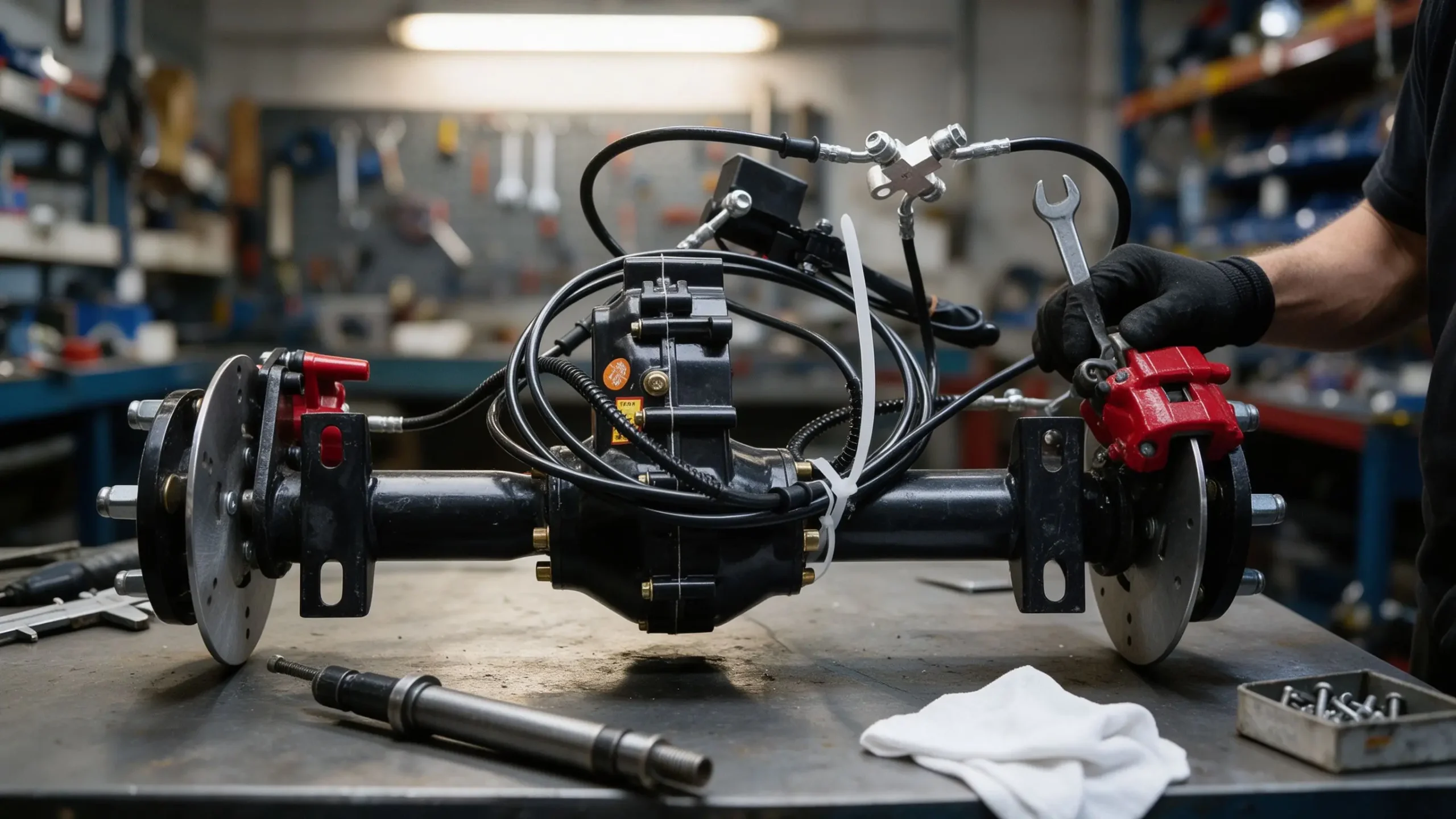
Ask a fleet manager which part of a cargo electric tricycle fails first, and you rarely get a vague answer. They will point under the vehicle and name the exact component that stranded a driver last month — a snapped half shaft, a controller that went dark after rain, a brake drum that ran out of lining. Failures in this business are not evenly spread. They cluster around a handful of high-load systems, and a service network that stocks the right electric tricycle parts stays open while the shop down the road waits weeks for a shipment.
ECOGO has built electric tricycle rear axle systems since 2010 and now catalogues 92 selected parts across seven systems. The guide below is based on what actually wears, and on what distributors should be checking — and stocking — before the rainy season or a delivery peak.
1. The rear axle and drivetrain take the real punishment
If there is one rule every new distributor should learn, it is this: the drivetrain works harder than the rest of the vehicle. An electric tricycle rear axle assembly has to handle the loaded weight, transfer motor torque through the differential, survive braking forces and twist over potholes at the same time. It is the highest-stress area on a cargo model.
What typically fails, in order:
– Half shafts and splines — the 18-tooth and 20-tooth suspension half shafts twist or strip under repeated overload and hard starts on inclines. Half shaft replacement is one of the most common repair jobs in any busy service shop.
– The differential and gearbox — the electric tricycle differential gearbox develops noise, oil leaks or gear wear when lubrication is skipped or load exceeds the axle grade. Integrated gearbox housings and split gearbox housings are different structures and are not interchangeable.
– Bearings and seals — worn bearings announce themselves with hum or heat; failed seals leak gear oil into the brake area, which then ruins brake performance.
– Mounting plates and torque stays — the small and big rear axle plates crack or loosen when bolts are not retorqued after early service.
A practical check is simple: lift the rear, rotate the wheels, feel for play, listen for gear noise, look for oil streaks and confirm the axle grade matches the route’s real load. A light leisure vehicle and an overloaded market hauler should not run the same axle.
2. Controllers and motors fail fast when they are mismatched
Electrical faults are less dramatic than a broken shaft but can disable a vehicle just as completely. The controller and the motor are a matched pair, and swapping in a convenient-looking substitute is a classic cause of repeat failures.
The controller manages the power from battery to motor. ECOGO supplies controllers from 500 W through 3,000 W, including a 24-MOSFET digital display unit for 1,000–1,500 W systems and a 36-MOSFET controller for 1,500–3,000 W drivetrains. An electric tricycle controller 1500W unit installed where a 3,000 W motor is running will overheat and cut out under load; the reverse pairing wastes money and can deliver power too abruptly.
Water, loose connectors and heat are the usual culprits. Signs of trouble include sudden power loss, error codes on a digital display, burn marks at the connector, and a controller that is hot to the touch after a normal run.
The motor itself is comparatively long-lived, but brushes aside — most current cargo models use brushless square-shell or square-wave motors. A 72V electric tricycle motor and controller must be selected together, and mounting dimensions, shaft style and connector photos all need to match the old unit. A motor that groans, loses torque uphill or triggers the controller repeatedly is usually signalling a pairing problem rather than a dead motor.
3. Brakes and suspension are safety stock, not optional stock
On a loaded three-wheeler, brakes are the part nobody wants to be out of. Brake drums, shoes, hubs and hand-brake levers wear with mileage and get contaminated quickly when axle seals leak. Electric tricycle brake and suspension parts should sit in every starter stock order because they are needed urgently, fitted often and are relatively cheap to keep on the shelf.
Leaf springs and shock absorbers fatigue quietly over months. A vehicle that sits lower on one side, clunks over bumps or wanders under braking is usually showing tired suspension rather than a bent frame. Riding on collapsed springs also accelerates axle and tyre wear, so replacement is a maintenance decision, not merely a comfort one.
4. Lighting, switches and cabin electrics
This group causes the most roadside downtime per dollar of part cost. Headlights, spotlights, indicators, dashboards, accelerators (throttles) and switches are exposed to rain, vibration and knocks. They are also among the easiest items to stock and fit. For an evening or night-route operator, a failed headlight or a dead accelerator means the vehicle stops earning immediately.
What a sensible starter stock looks like
Distributors opening a new market should not order equal quantities of everything. Stock follows failure frequency:
1. Rear axle and drivetrain: half shafts (both tooth counts), differential and gearbox components, bearings, seals, mounting plates.
2. Electrical: controllers at the wattages used by the local fleet, matched motor spares, accelerators and connectors.
3. Braking and suspension: brake drums and shoes, hubs, hand-brake levers, leaf springs and shocks.
4. Body electrics: headlight and spotlight assemblies, switches and dashboard units.
This is exactly the logic behind ECOGO’s electric tricycle spare parts wholesale program — fast-moving replacement systems first, mixed cartons rather than forced full-vehicle orders, and repeat replenishment planned around how often each part actually fails.
What to send before ordering parts
Half of all parts back-and-forth is avoidable. When you make an inquiry, send: clear photos of the part (front, side, connector and label); the vehicle type and its load use; voltage and wattage for electrical items; key dimensions, mounting-hole spacing and brake type for mechanical parts; and the quantity you need. With a photo and the mounting data, most electric tricycle rear axle and drivetrain parts can be confirmed before payment — no guesswork, no wrong shipment.
Service teams and distributors can request the parts catalogue, use the parts selector at ecogoev.com, or contact the export team on WhatsApp +86 198 5169 9562 to build a starter stock list matched to the local fleet.