Rear Axle Load Capacity for Cargo Tricycles: What Buyers Should Verify
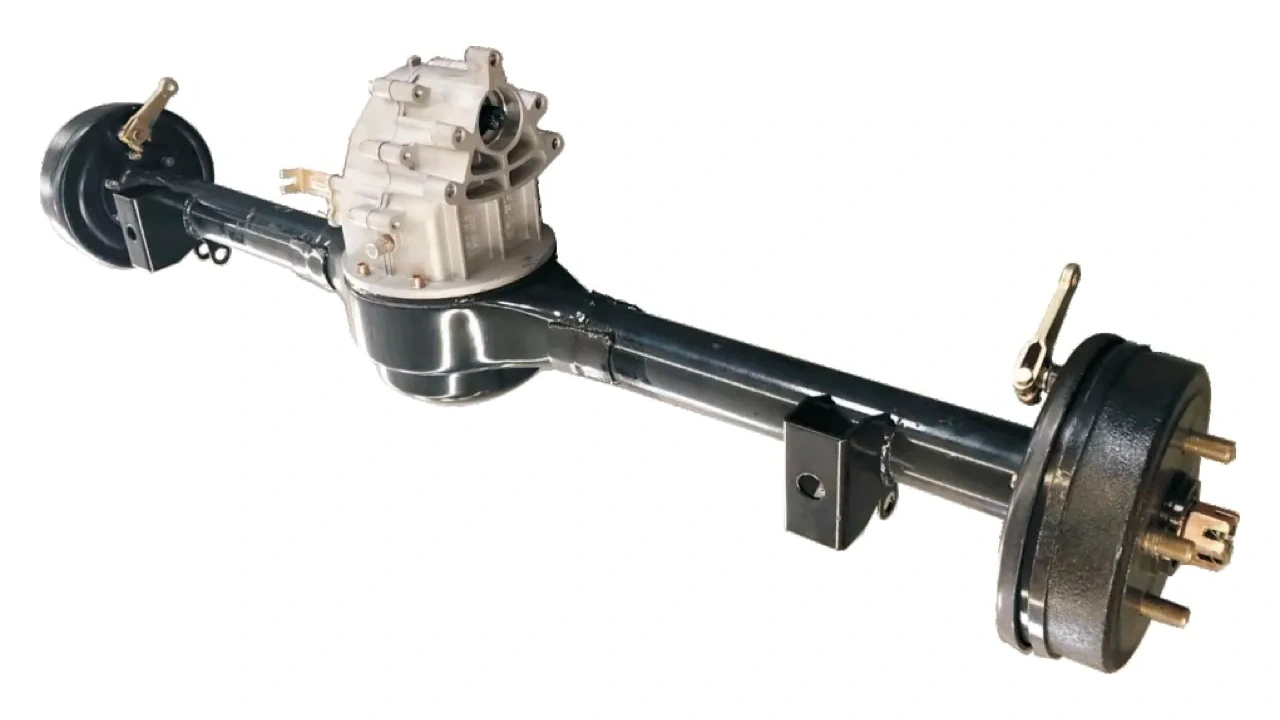
Rear axle load capacity for a cargo tricycle should be checked against the load that actually reaches the rear axle, using the intended wheels, mounting arrangement and operating conditions. Cargo weight alone cannot establish that requirement: the rear axle supports part of the vehicle, battery, driver and load, while the front wheel supports another share.
When comparing ECOGO’s electric tricycle rear axle and drivetrain parts, establish the expected axle load, ask what the supplier’s rating describes, and check whether it applies to the proposed installation and route. These checks help assemblers, distributors and replacement-parts buyers turn a payload request into a specification that can be reviewed before ordering.
What Does Rear Axle Load Capacity Actually Mean?
Payload, Gross Vehicle Weight and Actual Rear Axle Load
A payload figure describes what the vehicle carries; an axle load describes how much of the loaded vehicle is supported at that axle. They answer different questions. In an RFQ, state whether “payload” means cargo alone or also includes occupants and other carried items.
| Term | What to establish | How it informs the purchase |
| Cargo mass | Goods, packaging and any transport containers included in the stated load | Defines the carrying requirement, but not its distribution between the axles |
| Actual loaded vehicle mass | The complete vehicle in a stated operating condition, including its equipment, occupants and cargo | Provides the total that must be distributed between front and rear supports |
| Actual rear axle load | The combined load supported by both rear wheels in that condition | Provides a basis for comparison with applicable rear axle limits |
| Rated limit | The maximum declared for an identified component or vehicle configuration under stated conditions | Establishes a limit only within the scope of that declaration |
Use the vehicle’s mass records consistently. If the battery and cargo body are already included in an empty-vehicle measurement, do not add them again when calculating the loaded condition.
A Component Rating and a Vehicle Axle Limit Have Different Scopes
An axle assembly’s declared capacity is a component specification. The vehicle manufacturer’s rear axle limit applies to the installed vehicle configuration. Where documentation uses the term gross axle weight rating, or GAWR, it refers to a rated limit rather than a measured load. Terminology may differ between vehicle documents.
A product listing headed “Rated payload” needs a further explanation: does it describe recommended cargo use, a complete vehicle’s payload, or the axle assembly’s own load rating? Confirm the meaning, units and configuration before comparing figures from different suppliers.
How Can Buyers Establish the Actual Rear Axle Load?
Record Empty and Loaded Axle Weights
For an existing vehicle, obtain front and rear axle readings for the relevant loading states. Record the battery, driver, body equipment and cargo present during each measurement. An empty vehicle, a typical delivery load and the proposed maximum load can produce different axle distributions.
Use comparable measurements on level ground, with the vehicle supported in its normal attitude. Also consider whether uneven cargo placement requires individual rear-wheel readings: a satisfactory combined rear axle load does not establish that both sides are equally loaded.
Account for Cargo Position, Battery Placement and Vehicle Geometry
Moving cargo rearward generally transfers more of its static load to the rear axle. Moving the battery or fitting a different cargo body can also change the empty vehicle’s distribution. Therefore, do not assume a fixed rear-axle percentage or divide vehicle mass equally between three wheels.
Hypothetical static example: consider a vehicle with a 2.0 m wheelbase on level ground. A 200 kg load whose center of gravity is 1.0 m behind the front axle adds 100 kg to the rear axle scale reading. Moving the same load’s center to 1.5 m behind the front axle increases that contribution to 150 kg. The cargo mass has not changed, but its contribution to the rear axle reading has increased by 50 kg.
This simplified example assumes a stationary vehicle and considers only the added cargo. The existing vehicle’s rear axle load must still be included; the calculation does not establish dynamic suitability or an axle rating. For a new design without measured axle weights, supply a layout, component masses and load positions for engineering assessment.
Which Operating Conditions Must Accompany the Load Rating?
Road Surface, Speed and Repeated Loading
A static load figure does not describe the full service duty. Road impacts, repeated loading and cornering impose conditions that an axle application review must address. Describe the expected surface, operating speed, delivery frequency, daily use and the proportion of operation at full load.
A slow vehicle on a smooth site and a vehicle carrying the same mass over broken roads present different application conditions. Ask which conditions the supplier’s rating and supporting assessment cover. There is no universal multiplier that converts a cargo weight into a suitable axle specification for every route.
Separate Load Carrying from Drive Torque and Braking Duty
Vertical load, drive torque and braking duty require related but distinct checks. Motor power or gear ratio alone cannot establish how much weight an axle can carry. Likewise, a suitable load rating does not establish that the selected gearing or brakes are appropriate for the route.
Include hill starts, slope length, repeated stops and loaded descents in the application description. Compare static axle loads with the relevant limits on a consistent basis, then establish how impact, fatigue and braking requirements are addressed. Do not compare an estimated momentary impact force directly with an unexplained catalog capacity.
Which Axle and Vehicle Interfaces Need to Be Checked?
Axle Dimensions, Mounting Points and Wheel Interfaces
Axle overall length, distance between wheel mounting faces, track width and suspension mounting centers are different dimensions. State the measurement points on a drawing. Wheel offset and the position of the supports affect how forces act on the housing, bearings and mounts, even when the total supported load is unchanged.
ECOGO’s 158 Heavy-Duty Cargo Rear Axle is a relevant reference for cargo applications, with fitment checks covering axle length, brake type, mounting distance and shaft details. For a purchase request, identify the exact version and these interfaces; the product name alone is not a load specification.
Tires, Hubs, Suspension, Brakes and Frame Connections
Check the complete load path from tires and wheels through hubs, bearings, axle supports and frame connections. Confirm the tire and wheel capacities for the actual application, together with the suspension and brake configuration. A visually similar replacement can still differ in a mounting or wheel interface that matters to the installation.
Installing a higher-capacity rear axle does not automatically increase the vehicle’s rated payload. The frame, tires, brakes, stability and vehicle limits remain relevant. Adding the front and rear axle ratings also does not establish a new permissible vehicle gross weight.
What Should a Supplier Confirm Before You Accept a Load Rating?
The Model, Configuration and Meaning of the Rating
Ask the supplier to associate the load statement with an identifiable model, drawing revision and supplied configuration. Record the housing or assembly variant, mounts, wheel interfaces, brake arrangement and any restrictions that affect the declaration.
Keep the definition beside the number in the quotation comparison. Two figures are comparable only when they describe the same type of load and relevant conditions. If a drawing, catalog and quotation disagree, obtain a reconciled specification rather than selecting the largest figure or assuming the newest document describes the same variant.
Operating Limits, Supporting Documents and Supplied Parts
Ask what supports the rating, such as a documented engineering assessment, component test or vehicle application approval. Check the model, load arrangement, mounting setup and duty addressed by the evidence. A test result for another installation or a general quality certificate does not, by itself, establish capacity for the proposed cargo tricycle.
Also clarify what the quoted assembly includes. Hubs, brakes, shafts or other associated parts should be identified where they form part of the configuration being assessed. An initial quotation may precede final application approval, but the remaining technical decisions should be resolved before approving the assembly for the intended use.
What Data Should You Include in a Cargo Tricycle Rear Axle RFQ?
Buyer Information for an Initial Review
A useful request for quotation links the intended load case to the vehicle layout and installation. The following information helps a supplier identify a candidate and determine which application details still need confirmation.
| Information | Buyer provides | Supplier confirms |
| Vehicle and existing part | Vehicle type, application, model references and clear axle photographs | Proposed model, variant and replacement or integration scope |
| Mass and load distribution | Cargo mass and position, available axle readings and the measured loading state | Load-rating definition, applicable configuration and further evidence needed |
| Mechanical interfaces | Dimensioned layout, mounts, wheels, tires, shaft details and brake arrangement | Drawing dimensions, interface compatibility and supplied parts |
| Operating duty | Road conditions, speed, slopes, start-stop duty and drive-system details | Application limits and the basis for suitability |
| Order requirements | Sample or batch quantity, destination and required documentation | Quotation scope and the confirmation stages before supply |
Supplier Confirmation Before Sample or Bulk Approval
An inquiry can start without a complete axle-weight record. Provide the available photographs, dimensions and vehicle layout, and distinguish measured values from design targets. This allows an initial review without presenting an estimate as a verified load case.
Before sample or production approval, agree the drawing, configuration, load definition, operating conditions and acceptance checks. Confirm who will assess the completed vehicle; checking an axle’s dimensions alone does not validate the vehicle’s carrying capacity.
To request a rear axle fitment review, send ECOGO the vehicle application, axle photographs or drawings, available load information, quantity and destination. A clear request allows the proposed axle and its stated limits to be considered together, so the purchase decision rests on an identified configuration and use case.